

Patrick

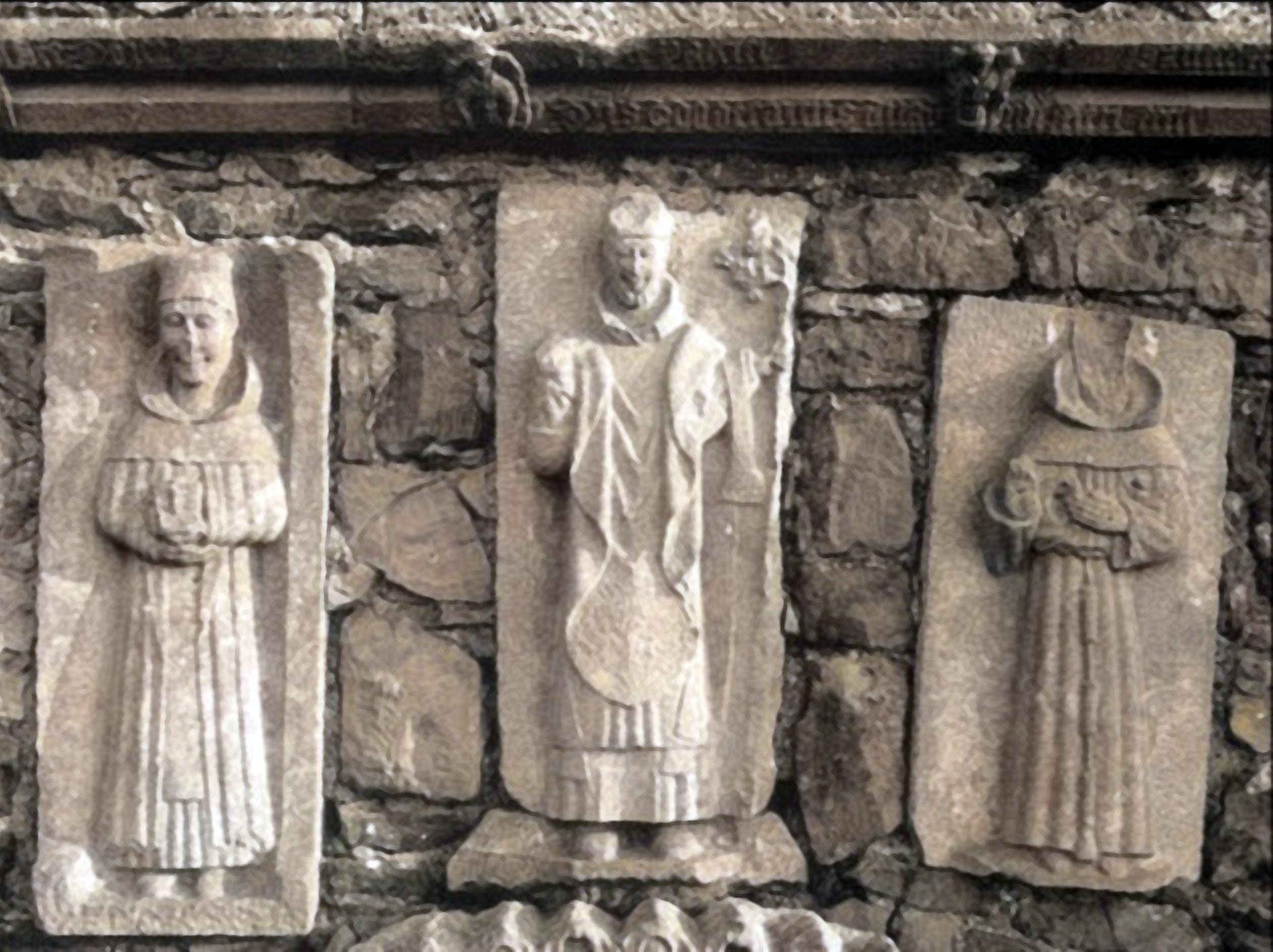
[Image: Carving of St Dominic, St Patrick and St Francis over cathedral door in Clonmacnoise, County Offaly, Ireland, created circa 1460]
A "saint" who was never made a saint by the church which claims him.
Culturally he was almost certainly a Briton or Welshman. Or more specifically, he was "Romano-Welsh", born in about 386 CE to wealthy parents who lived and prospered at the outer British fringe of the Roman Empire.
In 386 CE, Wales encompassed lands now lying in Wales, Cornwall, and southern Scotland.
Many scholars believe the man celebrated today was from the part of ancient Wales now lying in SW Scotland.
His real name will probably never be known for certain - some believe his native Welsh name was "Maewyn Succat", but it is not impossible that his ethnic roots lay elsewhere within the Roman Empire, and his parents just happened to be living in Wales at the time of his birth.
History has remembered him as "Patrick", from the Latin name "Patricius" - meaning "noble one".
"Padraic" or "Padrig" to his Gaelic-speaking contemporaries.
"Paddy" to many of his friends today in Ireland.
Not "Patty", as often seen in the USA...
*****
At the time of Patrick's birth in about 386 CE, Roman-ruled sections of Britain had only recently been introduced to Christianity, following upon Roman Emperor Constantine's own conversion to that faith a generation or two earlier.
In Roman Britain, Christians were seen as just one religious cult among many.
Any territory which was part of the Roman Empire became a place of ethnic diversity. Military garrisons, bureaucrats, and merchants arrived from all corners of empire, with religious practices in Britain ranging from the worship of traditional Roman gods (like Jupiter and Mars), to the cults of Cybele (from Phrygian Anatolia) and Mithras (with ancient origins in Persia or Iran).
Patrick's parents, and one of his grandfathers, adhered to the newer cult of Christianity - but not Patrick.
Patrick also happened to be born about three years after the armies of Rome were withdrawn from Great Britain, following over three and a half centuries of occupation and indigenous British-Roman cultural integration.
Ireland, Wales, Cornwall, Scotland, and the Isle of Man had remained on the fringe of the Roman Empire, retaining their own distinct “Celtic” languages, laws, and cultures.
The place now called England, on the other hand, had become a hybridized society, with its original “Celtic” or “British” population augmented and overlaid by 300 years of colonization and immigration from various parts of the Roman Empire.
Do not confuse the ancient “Celtic” Britons or "British" peoples like the Iceni or Trinovantes with later Germanic "proto-English" immigrants such as the Angles, Saxons, or Jutes.
These latter northern European pagan peoples (who had never fallen under complete Roman control) were not slow in spotting the now poorly defended island of Britain - raids for booty and land settlement began in earnest after the withdrawal of Rome’s legions.
Germanic peoples from what is now Northern Germany and Denmark arrived in boats from coasts lying to the southeast of Britain.
"Picts" swept down from Caledonia (later Scotland) in the north, and the Irish or Gaels raided from Hibernia, across the Irish Sea to the west.
This is the time of chaos and violence which would give rise to the later legends of King Arthur, who may have been a Romano-British warlord who managed to fend off many of the Germanic, Pictish, and Gaelic raids.
*****
It was during one such Irish raid on the west coast of Wales that Maewyn Succat was taken prisoner (according to his own account), and sold as a slave to an Irish buyer, who set him to work as a herdsman for many years - most likely somewhere in or around present-day County Antrim in northern Ireland, among the "Scoti" - a Gaelic-speaking people who would later go on to colonize parts of Pictish Caledonia, eventually amalgamating with the Picts and giving that nation its modern name - Scotland.
It was only during his six years of slavery that Maewyn began to cling to the faith of his fathers.
Maewyn eventually escaped back home to Wales, spent some time travelling, and acquired an education.
Around the 450s CE, something compelled him to return to Ireland - this time operating out of what is present-day County Mayo.
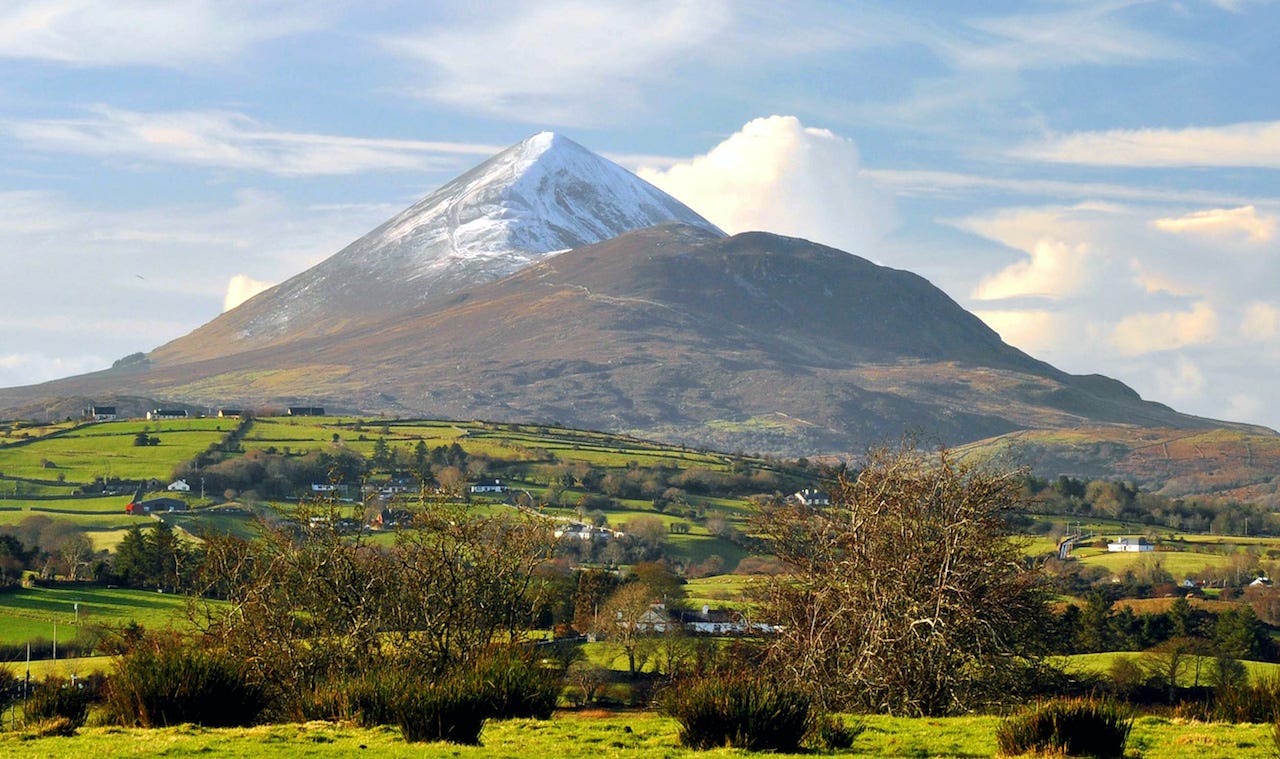
[Image: Croagh Patrick in County Mayo, Ireland, a place of Catholic pilgrimage where tradition holds that Saint Patrick spent 40 days fasting]
His own account tells of him feeling compelled to share his growing sense of Christian religious fervour with the pagan Irish. A pragmatist or cynic trying to read between the lines might see an opportunist whose first-hand knowledge of Ireland gave him an insight into the ways he might “monetize his connections”.
Even his own own writings hint at financial improprieties in his dealings.
Patrick was not the first Christian missionary in Ireland. That distinction belongs to Palladius, who was sent in 431 CE to act as a bishop to the few Irish who had already accepted the Christian message - probably through trade contacts with Christianized Romano-Britons in the east of Ireland.
The Roman Catholic Church claims that their own Pope Celestine sent Maewyn/Patrick to Ireland as a missionary, but there is simply no documentary evidence for this claim.
In fact, the monastic and apostolic style of Christianity practiced in Ireland during the Early Middle Ages was decidedly non-Roman in many respects.
"Patrick" is the only known Romano-Welsh or Romano-British Christian to have written of his own life and thoughts, and he says nothing of being sent by the Roman Church to Ireland, nor do contemporary or near-contemporary Roman Catholic Church records mention him.
It would seem that Patrick was simply part of a wider grassroots Christian cult which was popular at the time.
British, Welsh, Gaelic, and Gallic Christians might have respected or even venerated certain “famous” Roman Christians they had heard about, but they were most certainly not "Roman Catholics" in the modern sense of the term.
*****
Ireland is the only "pagan" nation believed to have become almost wholly Christianized without widespread bloodshed.
When I first published this piece, many readers of a leftist persuasion expressed doubts about this assertion, with many becoming downright hostile, believing that I was attempting to whitewash the violence and coercion which has ridden shotgun with the Catholic Church for centuries.
This is to misunderstand the evolution of European Christianity. The early Christian Church within the Roman Empire had only become the official state religion of Rome during the early 300s CE.
The 100-200 years between Constantine’s conversion and the birth of Patrick had not been time enough for the church to become the all-powerful bureaucratic institution we know from medieval times. Patrick was born centuries before the church had become so wealthy and intertwined with secular power that it could launch wars and crusades against its enemies.
As noted earlier, the cult of Christianity had barely had time to make a dent in British society before the Romans withdrew, leaving no state monopoly on violence in place able to enforce any state religion, even if they had wanted to do so.
This is why Romano-British Christians like Gildas were left to rage and rail over the next decades, watching Britain became less and less Christian, as more and more pagan “Saxons” arrived.
So no, Patrick did not arrive in Ireland with a Christian army behind him.
Which invites the question: Why did Ireland’s chieftains so readily embrace this new religion?
Viewed from a strictly secular position, it is worth pondering whether Patrick’s success was due not so much to the power of his Christian message, but also due to the introduction of other things which came as “part of the package”.
The European Christian church offered advantages which the indigenous Druidic caste could not.
Missionaries for the Christian church were among the most educated, literate, and NETWORKED people of their time.
Literacy would have been an awesome power in a largely pre-literate society.
The ability of these Romanized missionaries to store ancestral memory, poetry, legal and religious tracts, and FINANCIAL ACCOUNTS on parchments, rather than within physical human memory like the Druids, must have been a game-changer.
During Patrick‘s travels to places like Mayo, Irish chieftains in these remoter parts of the island would have been quick to recognize the potential for taxation management and trade expansion which came with literacy and Roman-style bureaucratic models.
And once again, it is important to reiterate that these Christian missionaries did not bring just literacy and the gospel to Ireland.
They brought a whole new worldview, and a promise of access to a much wider international network - for knowledge, for exchange, and much else.
In short, a chieftain or minor regional king could become much more connected with faraway centres of commerce and power by linking into the only pan-European organisation left standing after the break-up of the Western Roman Empire.
All of these “selling points” eliminated much of the raison d’etre for the entire Druidic stratum/class of society - a class which had hitherto been extremely powerful - and replaced that class with literate Christian monks.
Patrick's own "Confessio" hints at these struggles and intrigues - and this history is far more interesting than later folk tales and legends fabricated by the medieval Catholic church - tales of snake banishing and various other outlandish "miracles" meant to appeal to a credulous peasantry.
It is worth repeating again and again that the early medieval Christian church and its monasteries in Ireland were patronized and overseen by Irish chieftains - NOT the Catholic church or its pope in Rome.
Only the invasion of Ireland by Anglo-Normans under Henry II of England (in 1169 CE) would force Ireland into the clutches of papal authority.
Thus began the slow decline of high Gaelic culture under the twin colonizing forces of England and Rome.
So there you have it - Patrick was not Catholic.
And technically, Patrick isn't even a saint!
His life and works took place in a time before the Catholic church rules for canonization had even been devised and laid-down.
Whatever about technicalities, he was being venerated as the patron saint of Ireland within the Irish Christian church by the 7th century, and his day was traditionally marked by sombre reflection and prayer.
Until 19th and 20th century Irish-Americans changed gears...
Lá fhéile Pádraig sona dhuit!