

Inappropriate
Why Do So Many Americans Like To Pretend They Are Indians?

“I check my look in the mirror. Wanna change my clothes, my hair, my face...”
Bruce Springsteen [1984]
The confirmation of Markwayne Mullin as the new head of the Department of Homeland Security this week got me to thinking.
You see, lots of people have been making quite a big deal about the fact that he identifies as Cherokee, and is an enrolled member of the Cherokee Nation in Oklahoma.
From what I can gather, his cabinet posting has been greeted with mixed feelings among both the Cherokee and “white” American communities.
A lot of thinly veiled criticism - from sections of both communities - surrounds questions about his European appearance, and whether he is a true representative of Cherokee culture and values.
Does he embrace Cherokee identity only when it is beneficial to himself?
Some have even contended that he has chosen to “pass as white”, much as many Black Americans have done in the past, as a way to get ahead in a society which places “white people” at the top of a racial hierarchy.
A quick glance at the Wikipedia page listing the various Indigenous people who have held federal office might seem confusing to some. A substantial proportion of official photographs appear to portray what most would describe as “white people”.
There are a myriad of complicated reasons for this, all having to do with America’s profoundly mixed-ethnic history.
It has always been the position at Before We Were White that our upbringing and culture determine our ethnicity, not our genetic inheritance.
It is thus the prerogative of the wider Cherokee community to decide whether someone is “culturally Cherokee”.
But in the USA, where ethnic identity is so often weaponized, the situation can become deeply complicated, and even many Cherokee people are not immune to viewing identity through a discredited lens of genetic inheritance or “blood quantum”.
*****
For a start, we need to understand how a person becomes an “enrolled” member of the Cherokee in the first place.
It is important to note that there are three federally recognized Cherokee groups - the United Keetoowah Band of Cherokee Indians (OK), the Eastern Band of Cherokee Indians (NC), and the Cherokee Nation (OK).
Each has its own history and criteria for tribal citizenship.
The United Keetoowah Band of Cherokee Indians and the Eastern Band of Cherokee Indians require that an applicant for citizenship have at least one direct ancestor named on specific “tribal rolls”.
The United Keetoowah Band are the descendants of “Old Settlers” - those Cherokee who migrated into Arkansas Territory “voluntarily”, 20 years before forcible Indian Removal.
Applicants for UKB membership should have at least one direct ancestor named on the 1817 Emigration Roll. Because these Old Settlers later relocated to Oklahoma, applicants are also expected to have at least one direct ancestor named on the Old Settler Roll of 1851.
The Eastern Band of Cherokee Indians rely on an ancestor being named on the 1924 Baker Roll.
The largest tribe, the Cherokee Nation, requires that a direct ancestor be named on the land allotment documents known as the Dawes Rolls of 1907.
In short, a candidate for citizenship in any of these three tribes must have at least one ancestor who was explicitly named in what were essentially censuses of the Cherokee people.
The United Keetoowah Band of Cherokee Indians and the Eastern Band of Cherokee Indians further require that this ancestry has not become “diluted” beyond a certain degree of “blood quantum”, a highly contentious way of establishing identity.
The United Keetoowah Band of Cherokee Indians require at least one-quarter “Cherokee blood”, while the Eastern Band of Cherokee Indians require that an applicant must have at least one Cherokee ancestor who was 1/16 “pure” Cherokee, or two Cherokee ancestors who were 1/32 “pure” Cherokee.
The Cherokee Nation has no such “blood quantum” requirement, not least because many current members of the Cherokee Nation are members by dint of historical circumstance - for example, Cherokee Freedmen, who are the descendants of slaves held by the Cherokee during forced removal west.
As you can see, all of the foregoing leaves a lot of space for non-Cherokee ancestry in terms of genetic inheritance - especially among members of the Cherokee Nation.
What about people with Cherokee ancestry who didn’t happen to appear on any official rolls?
This is where self-identity can get messy and disputatious.
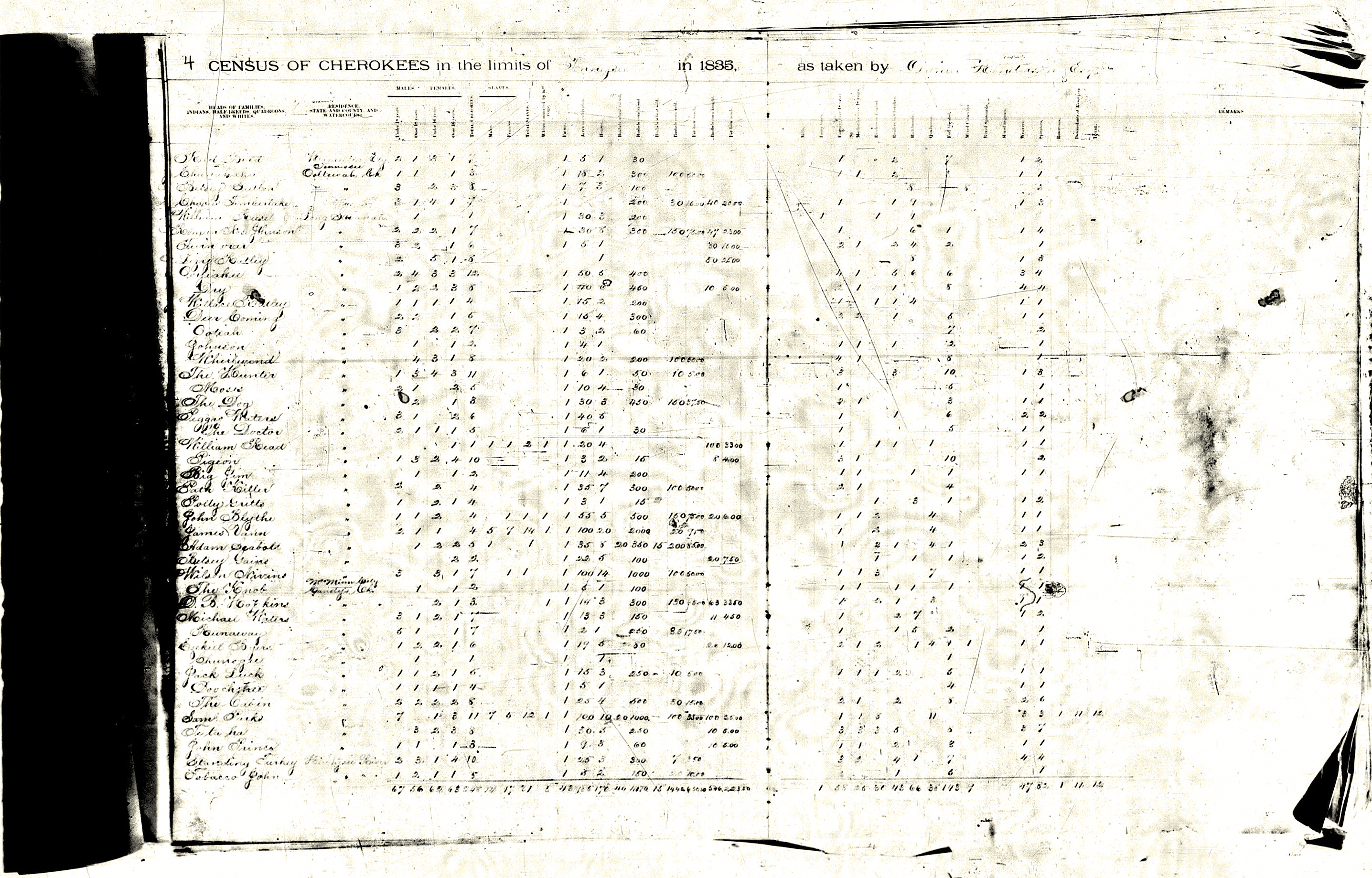
The Henderson Roll, the first 1835 census of the Cherokee (when their homeland was still largely in North Carolina, Tennessee, and parts of Alabama and Georgia), was undertaken for the express purpose of gathering the names of people and families being earmarked for later forced removal to reservations west of the Mississippi River.
These removals were the infamous “Trail of Tears”, which included members of the Cherokee, Chickasaw, Choctaw, Muscogee, and Seminole nations.
People with no ancestry in Appalachia are probably unaware of the level of intermarriage between “whites”, free persons of color, and local tribes in the decades between the 1770s and 1830s.
This is why almost all mixed-ethnic or Melungeon people from Southern Appalachian make vague claims of having an “Indian princess” in their family tree somewhere.
Here is the important bit:
Many, many settler-colonialists on the “frontier” had taken Indigenous partners, and raised mixed-ethnic families. Not “princesses”, just real women. And in rarer instances, Indian men.
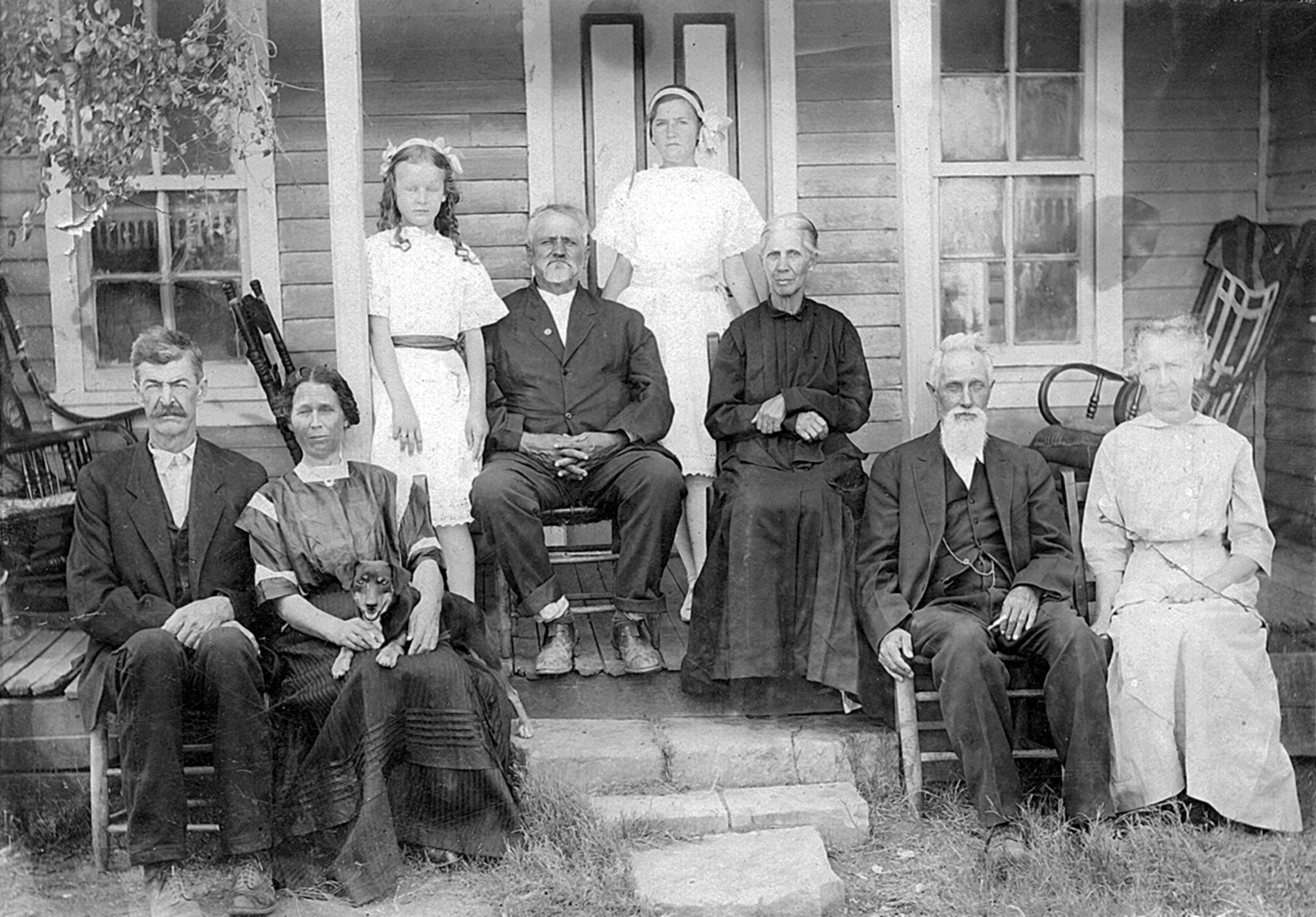
[Image: John Thurman and family of Sevier County, TN]
My own people were heavily intermarried among Cherokee people with Anglo surnames like Glass, Bunch, Blevins, Foreman, Ward, Martin, Benge, and others.
For many reasons, many of these mixed-ethnic families did not walk the Trail of Tears. Seeing the writing on the wall, some almost certainly refused to cooperate with census takers.
Clearly “white” men with Indian spouses tended to be left alone.
Besides, under the patriarchal principle of coverture, the legal status of a married woman (including her citizenship status), tended to be subsumed under that of her husband's.
If the head of a household was enumerated as “white”, then his entire family became “white” for legal purposes.
I have written extensively elsewhere about the mixed-ethnic background of most Appalachians. What happened when both the man of the house and his wife were “half-breeds” (to use the parlance of the time)?
Some census takers almost certainly refused to condemn a man in good standing in his community to the loss of his property by enumerating him as anything other than “white”.
Many families simply hid out in the woods and mountains when the US Army came kicking in doors and dragging people off to stockades.
These mixed-ethnic people would almost all eventually “pass into whiteness”, forming a large component of the demographic which would one day become “MAGA”.
I almost certainly have the same amount or more of “Cherokee blood” as Markwayne Mullin.
His ancestral claim (if my research is correct), appears to be based on one great-grandparent named Bert Morris appearing on the Dawes Rolls in 1907 (noted with one-sixteenth “blood quantum”).
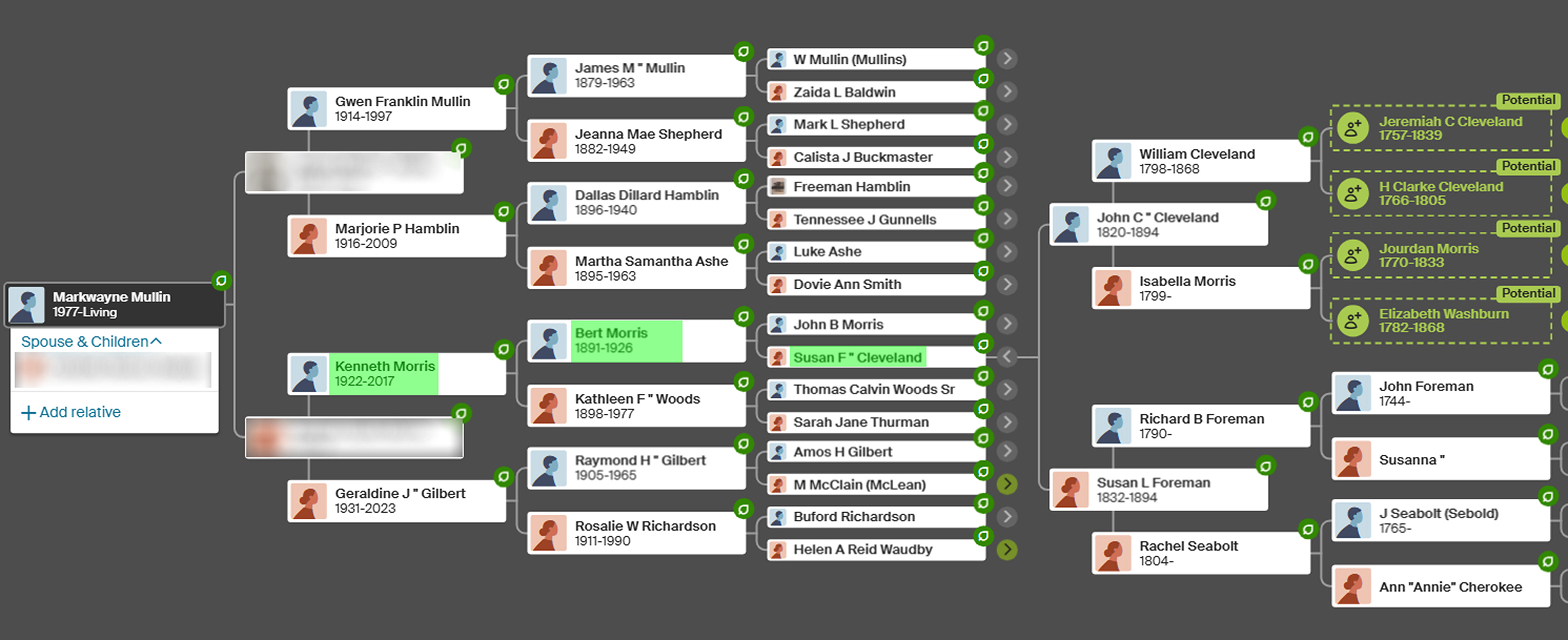
[Image: Family tree of Markwayne Mullin, with Cherokee ancestry highlighted]
Mullin’s Cherokee identity, then, must be tied up far more with his culture than his genetics. If they want him they can have him.
Do I think I am somehow Cherokee based on “blood”? Of course not.
I was raised within redneck American culture, for better or for worse.
But some people DO want to be Indians, even when they are not…
*****
Those of you who follow such things might have read a while back about the 1960s and 70s folk/protest singer and Indigenous rights activist Buffy Sainte-Marie, who was “outed” by CBC News in Canada.
For most of her life, Sainte-Marie has presented herself as being of probable Indigenous ancestry, claiming to have been removed from her natural parents and placed with a “white” family as a child.
For now, it appears that Sainte-Marie was born in Massachusetts to an Italian immigrant father named Alberto Santamaria and an American (possibly part-Mi’kmaq) mother.
At about the age of 23, Sainte-Marie visited the Piapot Cree reservation in Canada, where she was adopted into that tribe.
I will not presume to pass any judgment on the rights or wrongs of her choice of public identity.
But it is worth remembering the America into which Sainte-Marie was born.
When I was a child, “white” Protestant Anglo-American society commonly referred to Italian immigrants as “greasy wops” or “white n***ers”. I have read that this is the reason Sainte-Marie’s father changed the family surname in an attempt to disguise his ethnic origins.
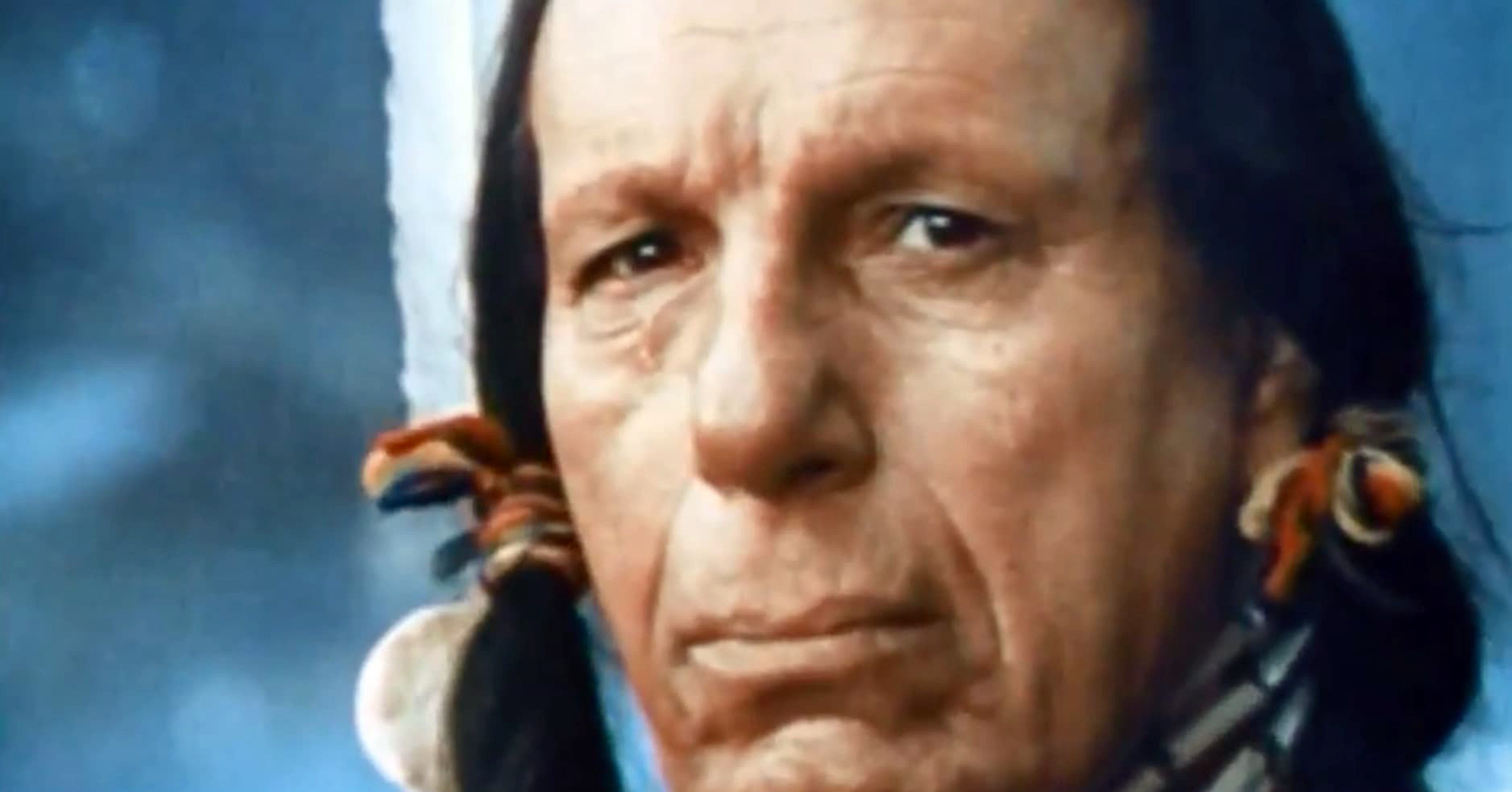
[Image: “Iron Eyes Cody”, the Italian American from the 1970s “Crying Indian” ad]
Being born into a country where such racism and bigotry was endemic and systemic, it is easy to imagine how a young girl of clearly dark complexion in the 1960s would want to change her clothes, her hair, her face.
Or to belong to a people where her hair and face “fit in”, and would be accepted.
Sainte-Marie has left a body of good music behind her.
Did you know she co-wrote the 80s smash hit “Up Where We Belong”?
Most of all, she has worked tirelessly as an advocate for Indigenous rights.
Despite this good work, the fact remains that if she is indeed a complete “ethnic fraud”, she stood on stages and accepted awards where real Indigenous people should have been standing.
But she is far from being the first “Pretendian”.
*****
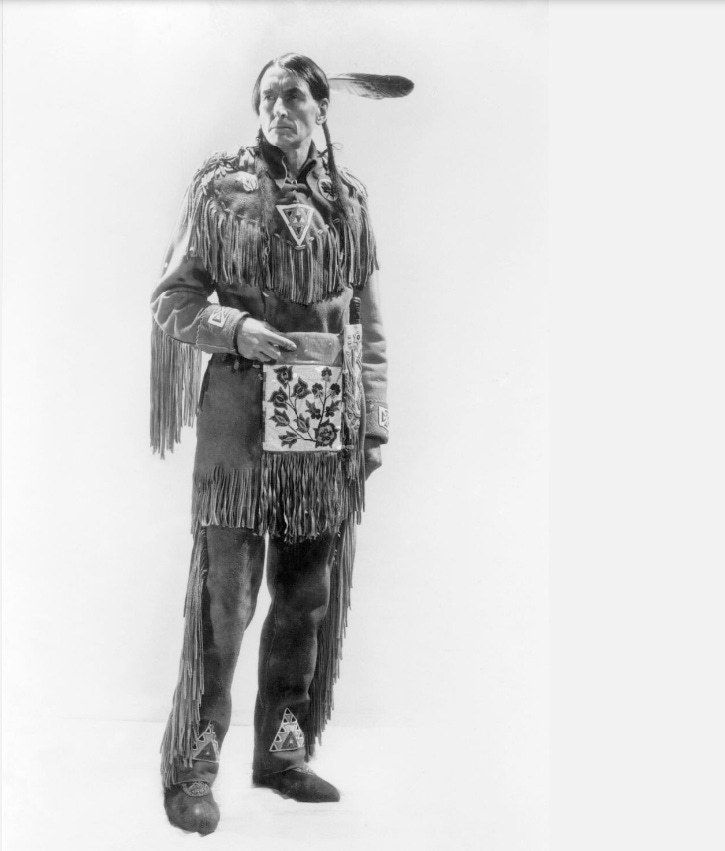
Meet “Grey Owl”, born 18 Sep 1888.
[Image at top of article]
A one time fur trapper for Canadian companies, he eventually came to understand the great damage being wrought upon the natural world by unregulated commercial exploitation of North America’s natural resources.
During his life, he wrote numerous books, becoming a renowned early spokesperson for the conservation movement. He was particularly passionate in his arguments for the protection of the North American beaver [Castor canadensis].
Grey Owl had French-Canadian, Mohawk, Ojibwe, and Métis wives and consorts during his relatively short life, and was father to at least 5 children. His much younger part-Algonquian, part Mohawk wife Anahareo should probably receive credit for first convincing Grey Owl of the evils of commercial fur-trapping (Happy Women’s History Month!).
Grey Owl died aged only 49, his health badly compromised by alcoholism brought on by his experiences during WWI.
After his death in 1938, it was revealed that he was in fact not half-Scottish, half-Apache as he had always claimed.
He was Archibald Stansfield Belaney, of Hastings in Sussex, England.
It is worth considering people like “Grey Owl”, when we argue about cultural and identity appropriation.
Perhaps the motivation of the impostor is more important than the actual identity they assume?
Many, many of us try on new skins as we move through life. Because our identities usually change incrementally rather than dramatically, it is often only late in life that we recognize our younger self as a complete stranger.
Would the world have listened to a damaged “Archibald Belaney” as he railed against environmental destruction?
Almost certainly not.
*****
I always go back to the great Palestinian scholar and writer Edward Said, when attempting to understand these things.
His 1978 monumental work - “Orientalism” - attempted to show how we view “the other” through our western lens, and project onto these “others” whatever it is we are needing to believe about ourselves in relation to the worlds outside our own world.
American Indians have become symbols to the people standing outside Indian cultural communities.
We try to force them to conform to OUR expectations, OUR vision of their meaning.
Nature wisdom. Noble savages. Holders of the keys to spiritual mysteries.
A people we have trapped in our minds like flies in amber at the moment of their destruction at our hands.
Except they are still here, and just like us, they have changed immeasurably since the time when our forefathers dispossessed them.
We must take them as they are, not as what we want them to be.
I think about Grey Owl, and I think about Markwayne Mullin.
Then I think about the rest of us.
So whose crime is bigger?
The crime committed by an impostor with a profound love of Indigenous culture and the natural world?
Or the crime of being so morally void that serving Donald Trump is an honor?
Or is the even worse crime actually the one committed by us, a people so culturally bankrupt and consumed by consumerism that we can only accept truth when it comes from a source beyond our inner moral compass?
From marketers, from Hollywood?
Or is the worst crime of all worshipping a “strongman” and his false idol, a Golden Calf on a golden escalator who reflects our worst impulses back at us, and gives us permission to act on them?
Why do so many of us need to project our secret dreams and innermost longings onto a third party, anyway?
Is this an admission that the culture and world in which we are complicit is so broken and hollow that we will accept the words of almost anyone claiming to have an answer?
Citizen of Cherokee Nation here. Thank you for your efforts, but things in Indian Country are confusing. I'm mentioning a few corrections:
1) Cherokee Nation does not have a blood quantum requirement at all. As with most nations worldwide, citizenship is based on descent. If you can show you are a direct descendent of someone on the Dawes Roll (and maybe some other rolls), you are eligible for citizenship. Blood quantums on the Dawes Roll were often based on appearances or simplified from a single ancestor. Most Cherokees are complicated fractions of mixed Cherokee, Choctaw, other tribes, white, Black, Latino, and other ancestors going back along multiple family lines. This is certainly the case with my heritage. During the Cherokee Trail of Tears, Principal Chief John Ross was 1/8th Cherokee, but all thru moms. As the Cherokee were still matrilineal at the time, he grew up with the tribe.
2) Cherokee women married to white men at the time of the Trail of Tears - and there were a lot of such marriages - were allowed to stay in Georgia/Tennessee with their white husbands. There is one example of that in my family, though many who stayed behind ended up moving to Indian Territory decades later. I don't really know their stories, just that many stayed back but then, years later, their death location was Indian Territory.
3) MarkWayne Mullin says very little about his Cherokee-ness and seems to keep it low profile. It is very awkward having a Cherokee in charge of an agency involved in ethnic cleansing. That's the most gentle way I can put it.
4) The Native American Studies dept at Univ of Minnesota just hosted a conference on pretendianism. There were quite a few panels, each over an hour. The Cherokee-focused one is here: https://www.youtube.com/watch?v=RGNyU7bS4os While there are only 3 federally-recognized Cherokee tribes (which are in regular communication with each other), there are about 400 faux-Cherokee tribes, which is rather overwhelming. One of the panelists says that more white people claim to be Cherokees than there are actual enrolled Cherokees, which says a lot because Cherokees are one of the largest tribes.
I have a little different story. My father's genealogy has been traced (by my uncle) but only through the father's in each generation. It stops when a "great-great some-grandfather) came to the colonies in 1769 from Belfast. The line ended up migrating through Virginia and ending up in what was or became Tennessee. My father always claimed that there was some Cherokee waaaayyyy back. Nobody ever claimed to be Indian of any kind. I never gave it much thought other than the possibility that somewhere along the way there was some intermingling, probably in the late 1700's. Not a given, just a possibility.