

Freedom 250: Part 2
DNA and Thomas Jefferson

Our total genetic inheritance is of course determined more or less equally by the genes carried and passed-down to us by our parents, and by extension, ALL of their ancestors, men and women.
Most of the DNA we inherit has been shuffled or “recombined” as it was passed-along, making us a mixture of our dad’s ancestors, and a mixture of our mother’s ancestors.
The exact mix of this autosomal DNA changes with every child born, and it is why one child might favor its mother, while another might be the spitting image of its grandfather.
A weird thing about genetics, though, is the fact that men inherit a certain part of their genes only from their direct father, and women inherit a certain part of their genes only from their direct mother.
This part of our genes is exempt from being thrown into the blender - and this small part remains largely unchanged over many generations, except for random mutations.
The genes which men inherit only from their father say very little about a man’s OVERALL genetic make-up. They merely tell us a little bit about a man’s father, and his father’s father, and so on.
That small portion of a man’s genes which he got only from his father (and thus from his father’s father) is called “Y” DNA.
Even if a man belongs to a “Y” haplogroup which is most common in Northern Europe, we should not take this to mean the man is ethnically “Northern European”.
*****
In an American context, for example, let’s say a slaveholder named “Smith” in 1690s Virginia fathered a son by an enslaved woman.
Let’s say this mixed-ethnic son grew up, was manumitted in his father’s will, took the surname “Smith”, and went on to have children with a woman of predominantly African ancestry.
Let’s then say that all of their children and grandchildren also took partners mainly from the African-American community over the next 300 years.
Any descendant of that early mixed-ethnic Smith alive today would most likely self-identify as “Black”.
And if that descendant were to take an autosomal DNA test, his results might show him to be 70% West African, 10% Indigenous American, 10% European, and 10% various “other”.
10% European admixture might seem a high percentage for someone with only 1 single DIRECT LINE Northern European ancestor, but we must remember that almost ALL African-Americans have some European ancestry, meaning that extra European DNA would have been acquired from multiple Black ancestors outside of one’s direct paternal or maternal lineage.
A “Smith” born today will usually carry a little bit of the European ancestry from ALL of his ancestors - reaching back perhaps six or seven generations.
But one thing will remain.
That persistent bit of Northern European DNA carried on the “Y” chromosome given to him by his father, and father’s father, and father’s father’s father...
In fact, if this “Smith” descendant showed almost ZERO percent European admixture in an autosomal DNA test, he would still carry the European “Y” haplogroup of his most distant paternal ancestor.
*****
So what is the value of knowing our mitochondrial (female) or “Y” (male) BNA haplogroup, if it says so little about our overall genetic inheritance?
Besides, our genetic inheritance is often utterly unrelated to our CULTURAL inheritance, which is where true identity resides, after all.
Because these haplogroups are extremely useful for understanding history, and mapping historical events such as slavery, migrations, population change, intermarriage patterns, and colonization.
Rather than telling us what we ARE, these DNA results can tell us what we once WERE (or weren’t).
A “white” heartland American evangelical family today might have a cherished piece of family folklore, recounting how their earliest ancestor “escaped religious persecution” and “stowed away aboard a ship in Scotland and made their way to America”.
But if all of the males in the family share a predominantly sub-Saharan African E-M2 haplogroup, then we can begin to doubt the family lore...
*****
Below is a table showing the currently known “Y” haplogroups of US presidents.
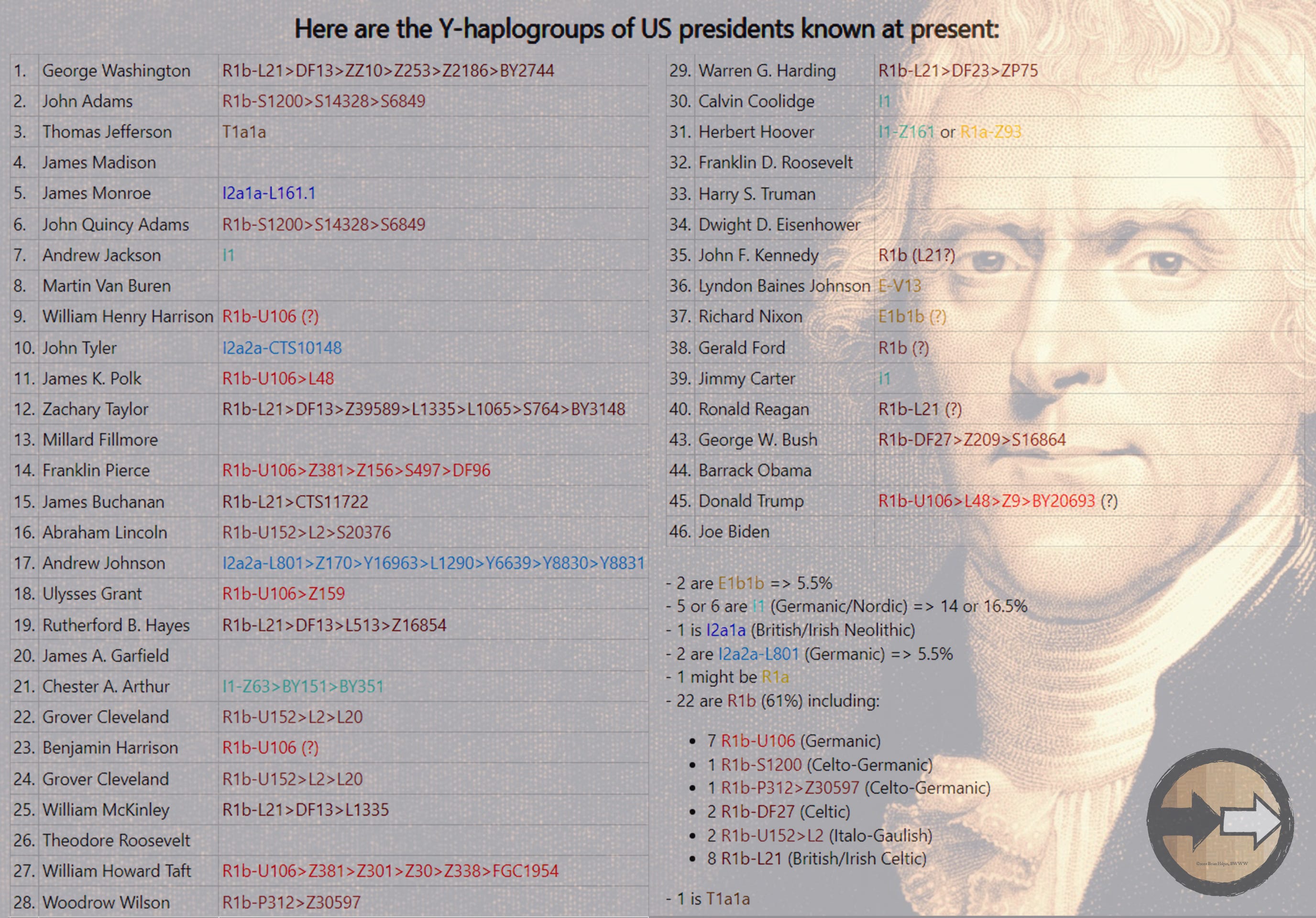
I have always been intrigued by the DNA haplogroup of Thomas Jefferson, one of the most consequential of US leaders.
Note that almost a quarter of presidential DNA remains unreported, for various reasons.
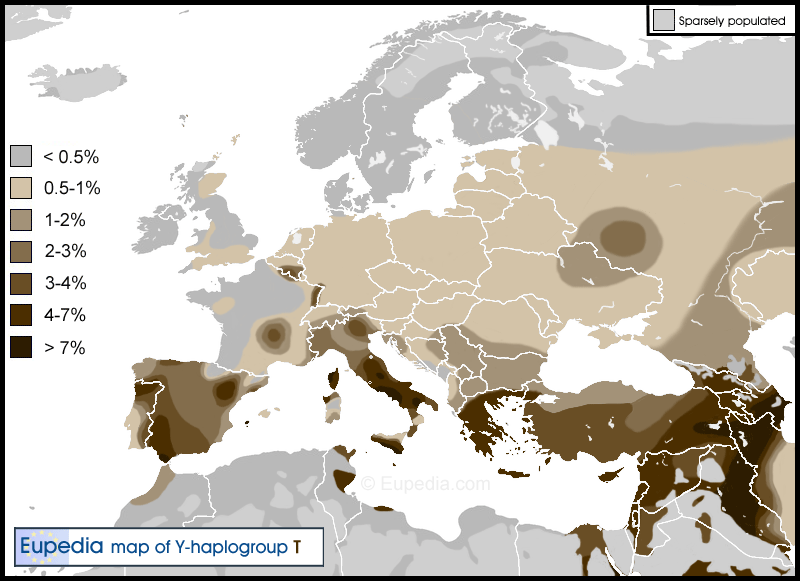
The T1a1a haplogroup of Jefferson’s descendants is vanishingly rare in most of the British Isles.
This haplogroup is less rare in Southern Italy and the Iberian peninsula, but it is by far most common in the Middle East and East Africa.
Most online genealogies attempt to connect Thomas Jefferson with the “Jeaffreson” families of Suffolk, England, but there is simply no solid documentary evidence to back-up such assertions.
Very unlike most elite families of that time, Jefferson himself was quite taciturn about his hereditary background.
We do know that English “Jeaffresons” held commercial interests in the Caribbean during the 1600s.
Those who listened to the three-part BWWW podcast episode “Pre-Deliverance” will have learned how England under Oliver Cromwell had reopened England and English colonies (especially in the Caribbean) to Jewish settlement.
Could Thomas Jefferson be the descendant of Sephardic (Iberian) Jews who “borrowed” the surname of a prominent merchant family of St. Kitts and Antigua?
His family certainly fits the profile of many colonial-era slaveholding Jewish people of South America and the Caribbean, who tended to intermix freely (i.e. sexually) with people of color, both slave and free.
*****
Everyone by now has heard of about Jefferson’s enslaved and underaged “lover” and consort Sally Hemings.
It is also interesting that Thomas Jefferson was not Christian.
Like many educated men of the time, Jefferson was drawn to the ideals of The Enlightenment, preferring that religious faith be based in rationality and reason.
The innumerable discrepancies (and tales of miracles) in Hebrew, Aramaic, Greek, and other religious texts had made Jefferson sceptical of both Christianity and Judaism, and he belonged to a school of religious thought called “Deism”.
Yet while maintaining a distance from religious dogma, Jefferson was fully supportive of extending full rights and religious freedom to Jewish people in America.
Was he a saintly figure?
Far from it.
His treatment of African-Americans, in particular his enslaved concubine Sally Hemings, makes that much crystal clear.
Was Jefferson important in terms of power and influence?
Absolutely.
And the modern science of genetics helps us to ask questions of America’s “Founding Fathers”, where previously they were believed to be of 100% nailed-on “white northern European” ancestry.
We’ll take another look at Jefferson in our mid-week newsletter...